
A human body submerged in water experiences two opposing forces: gravity, which pulls it down, and Archimedes’ buoyancy, which pushes it up to the surface. The outcome depends on a single parameter, the overall density of the body compared to that of water. When this density exceeds 1.0 kg/L (the density of fresh water), the body sinks.
When it remains below, it floats. This narrow threshold explains why two people of the same weight can have radically different experiences in a pool.
Body Density and Buoyancy: The Role of Each Tissue
The body is not a uniform block. It is composed of tissues with widely varying densities: fat is less dense than water, while muscles and especially bones exceed this value. The relative proportion of these three tissues determines the average density of the body.
A person with a low body fat percentage and a thick bone structure has an average density greater than 1.0. They naturally sink, even with lungs filled with air. Conversely, a more generous distribution of adipose tissue lowers overall density and facilitates floating.
The lungs act as adjustable ballast. Filled with air, they add a light volume that decreases overall density. When emptied during exhalation, this volume reduces, and the body becomes denser. Understanding the causes of not floating in a pool starts with this simple mechanics: the relationship between the volume of air in the lungs, muscle mass, fat, and bone density.
This is why a very muscular swimmer, with little subcutaneous fat, can sink like a stone at rest, while moving perfectly in active swimming. Propulsion compensates for what passive buoyancy does not provide.
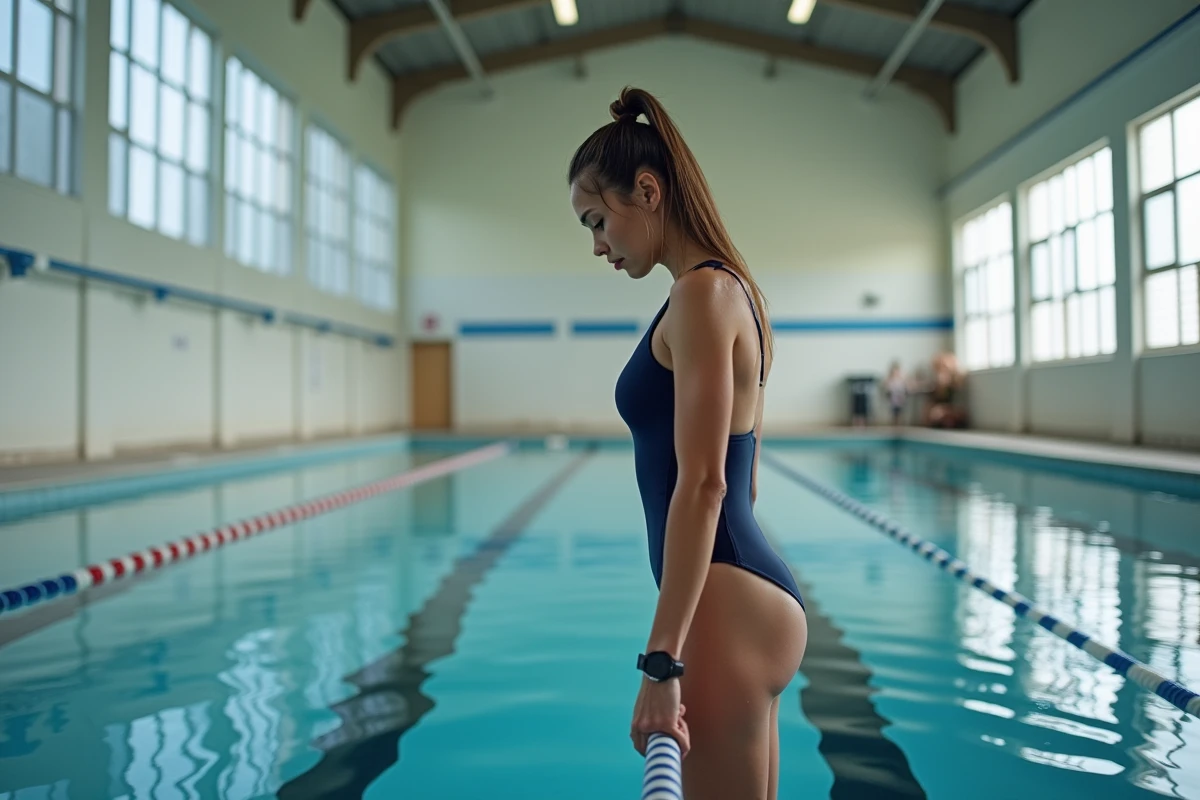
Breathing and Muscle Tension: Two Underestimated Factors in the Pool
Body composition tells only part of the story. The way a person breathes and holds themselves in the water significantly alters their ability to stay on the surface.
Shallow Breathing and Loss of Lung Volume
A study published in 2022 in the International Journal of Aquatic Research and Education showed that anxious individuals in water adopt a very shallow breathing pattern. This breathing pattern reduces the volume of air in the lungs, thus the overall volume of the body, without decreasing its mass. Density increases, and the person sinks further.
At equivalent body fat, these swimmers sink more easily than the control group as long as breathing and muscle relaxation are not corrected.
Reflex Contraction of the Trunk and Legs
Aquatic anxiety also causes involuntary contraction of the trunk and lower limb muscles. However, a contracted muscle is denser than a relaxed muscle, because contraction expels some of the water and blood it contains. This rigidity has a dual effect: it increases apparent density and prevents the body from spreading out in a horizontal position.
The result is a stiff, vertical body, with legs pulling downwards. The standing position in water concentrates weight on a reduced volume and worsens the sensation of sinking.
Freshwater, Saltwater, and Other Environmental Variables
The density of the medium matters as much as that of the body. Pool water (freshwater) has a density close to 1.0 kg/L. Seawater, laden with salt, exceeds 1.025 kg/L. This difference is enough to make a person float in the sea who sinks in a pool.
Water temperature also plays a role, in a more subtle way. Cold water increases reflex muscle tension and leads to short breaths, which ties back to the mechanisms described above.
Some medical treatments can change the equation. Research published in 2023 in Frontiers in Physiology indicates that treatments promoting water retention (some SSRIs, hormonal treatments) increase extracellular water volume. In subjects already very low in fat, this effect is measurable on buoyancy, even if it remains slight.
Techniques to Improve Floating in the Pool
Floating is not solely a matter of morphology. Several practical adjustments can compensate for high body density.
- Practice deep abdominal breathing before entering the water, then maintain a slow, deep inhalation to maximize lung volume while lying down.
- Adopt the starfish position (arms and legs spread) to increase the surface area in contact with the water and distribute weight over a larger volume.
- Use a pull buoy placed between the thighs to raise the legs, which are the densest part of the body for most adults.
- Focus on complete muscle relaxation of the trunk and legs, starting with exercises in shallow water to limit anxiety.
Swimming lessons focused on water comfort, rather than pure swimming technique, often yield better results for those who sink at rest. The goal is not to swim fast, but to learn to relax enough to let Archimedes’ buoyancy take effect.

Passive buoyancy remains inaccessible to a fraction of the population, particularly those with very muscular or dense bone structures. This is not a flaw in technique or a lack of will: it is physics. Adapting one’s breathing and posture in the water can help reduce the gap, but not always eliminate it. For these swimmers, active propulsion replaces passive buoyancy, and it is a perfectly viable approach to safely enjoy the pool.